


Apa saja jenis kateter balon?
-
 2022-10-25
-
LEPU


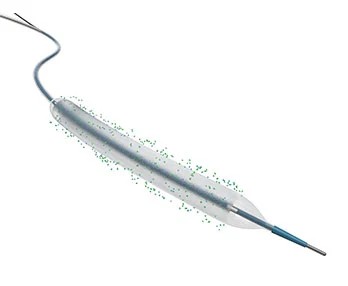
On January 16th, 1964, Dotter and Judkins performed the world's first lower limb vascular angioplasty on an elderly female patient using a balloon catheter. Thirteen years later, Gruentzig performed the world's first coronary angioplasty using a balloon catheter. Today, balloon dilation catheters are widely used for the diagnosis and treatment of cardiovascular diseases. Reviewing the development of balloon dilation catheter technology provides many insights for our current and future work. Next, let's take a look at the types of balloon catheters.
1. Kateter balon pertukaran cepat
The rapid exchange balloon dilation catheter is currently the most widely used type of balloon dilation catheter in percutaneous coronary intervention (PCI). The catheter has a side hole 25cm from the tip of the balloon, through which the guide wire is inserted and emerges from the side hole when it is inserted through the top of the balloon. This design greatly facilitates the operation of the operator and saves time. The structure of the rapid exchange balloon is also different from other types of balloons in that it includes a connection segment between the balloon and the push rod, occasionally leading to rupture. Both the balloon and guide wire are operated by one person, resulting in an ideal imaging effect. The disadvantage of this type of balloon catheter is that if the entire balloon system is not removed, the guide wire cannot be replaced. If an extension guide wire is not used, the OTW balloon cannot be replaced, and the push force is slightly reduced, and the tracking is slightly worse.
2. Kateter balon atas kawat
The over-the-wire balloon dilation catheter (OTW) was first used in PTCA in 1982. It can be used for CTO lesions or when guide wire exchange is required, as well as for interventricular septal chemical ablation and central cavity pressure measurement and blood sampling. Currently, OTW balloons are rarely used clinically. The advantages of the OTW balloon dilation catheter include easy exchange of guide wires and good tracking. When the guide wire is difficult to pass through the occlusive lesion, the OTW balloon can provide additional support, similar to the role of a microcatheter. If the guide wire still cannot pass through the lesion, the OTW balloon dilation catheter can be used as a transmission catheter to exchange other guide wires. After the guide wire passes through the lesion, the OTW balloon dilation catheter can also be used for distal angiography to facilitate judging whether the guide wire is located in the true cavity. Therefore, the OTW balloon dilation catheter still has certain advantages in handling CTO lesions. The disadvantage of this type of balloon catheter is that the balloon size is slightly larger and the length of the steel wire is 300 cm, requiring cooperation between two operators.
3. Kateter balon kawat panduan tetap
Kateter dildo balon memiliki kawat panduan plastik fleksibel terpasang di bagian atas kateter yang panjangnya 2 cm. Di antara kateter pelebaran balon yang umum digunakan, ia memiliki bentuk luar paling kecil, yang meningkatkan tingkat melintasi lesi dan menghasilkan efek pencitraan yang ideal, dan hanya membutuhkan satu orang untuk pengoperasiannya. Namun, ketika kateter memasuki pembuluh darah target, perlu didorong ke depan saat berputar ke kedua arah, membuat kateter rentan terhadap kerusakan. Tidak dapat bergerak secara independen, dan tidak dapat menukar kabel panduan. Pada dasarnya tidak lagi digunakan secara klinis.
4. Jenis kateter balon perfusi
Kateter dilhat balon perfusi memiliki banyak lubang samping pada proksimitas dan distral berakhir, jadi ketika balon dipompa, aliran darah masih bisa memasuki belahan akhir yang sakit.
Ketika rata-rata tekanan aortic adalah 80mm Hg, aliran darah distal masih bisa mencapai 40-60 ML/menit. Ketika tekanan balon terus-menerus diperlukan untuk mengobati komplikasi seperti perforasi arteri, penggunaan kateter pelebaran balon perfusi memiliki keunggulan tertentu. Kerugian utama adalah kateter yang relatif tebal dan memiliki kemampuan untuk menyampai area yang buruk.
5. Jenis khusus kateter balon
Jenis balon khusus saat ini digunakan dalam praktik klinis terutama termasuk balon kawat ganda, balon pemotong, balon drug-eluting, dll. Pada dasarnya, ketiga jenis balon ini adalah kateter penipis balon pertukaran cepat, tetapi mereka memiliki fungsi khusus yang berbeda dari balon pertukaran cepat konvensional.
Diameter luar dari balon kawat ganda mirip dengan balon biasa, dan ada lumen dalam pada ujung balon untuk memandu bentuk kawat. Selain itu, ada kawat tetap pada permukaan balon, terletak di posisi 180 ° di kedua sisi balon dari kawat panduan.
Balon kawat ganda dapat memotong jaringan plak secara teratur, dengan kerusakan minimal pada endotelio dan memastikan bahwa balon tidak bergeser. Balon potongan adalah produk yang menggabungkan teknologi pemotongan mikro dengan pelebaran balon. Balon pemotong yang saat ini digunakan secara klinis adalah produk generasi ketiga, yang memiliki pasabilitas yang lebih baik, dapat mencapai pelebaran penuh dengan tekanan yang lebih rendah, dan memiliki tarif rendah pengobek tidak beraturan pada Inova vaskular dan tingkat rendah pembesaran ulang dalam jangka panjang.
Balon drug-eluting adalah produk yang menggabungkan teknologi pantul balon tradisional dengan teknologi drug-eluting, dan secara bertahap menunjukkan keunggulan sebagai suplemen yang efektif untuk mengupas. Balon pengukur obat dapat menghindari efek samping yang disebabkan oleh stent logam dan pembawa polimer, dan dapat menerapkan obat untuk area tertentu pada dinding pembuluh darah yang sakit untuk mengontrol residu ulang.